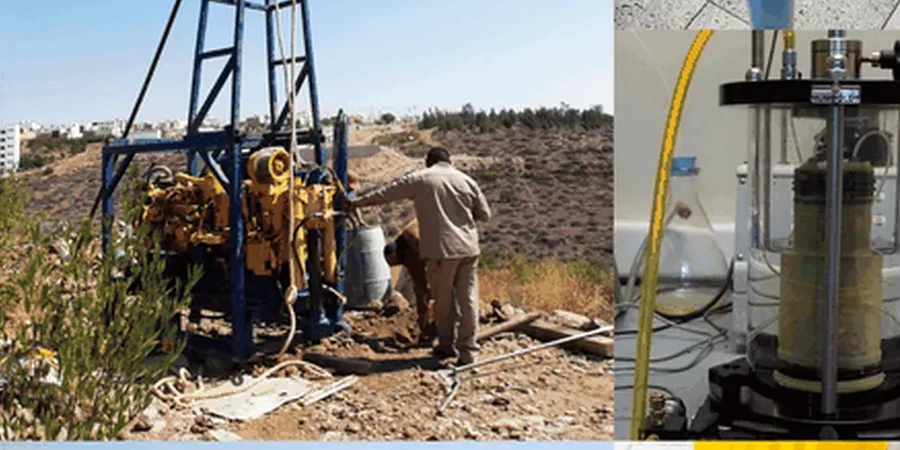
The National Building Code of Canada (NBCC 2020) mandates a comprehensive soil mechanics study before any foundation design in Ontario. In Brampton, this requirement carries extra weight. The city sits on a complex glacial stratigraphy—Halton Till overlying silty clay deposits and the Georgian Bay Shale formation. A standard visual inspection tells you nothing about long-term settlement or bearing capacity. The geotechnical team runs laboratory triaxial tests, consolidation analysis, and grain-size distribution to map the exact behavior of the substrate. For deep foundations near the Etobicoke Creek floodplain, we often combine this data with CPT testing to profile soft zones continuously, and with slope stability analysis when the site has more than 1.5 meters of grade change.
Brampton's Halton Till can look firm at surface grade but hide compressible silt lenses at depth—only a full soil mechanics study catches that.
Local considerations
A common mistake east of Airport Road is treating the entire soil column as competent till and skipping the consolidation test. Contractors place strip footings at 1.2 meters depth, and two winters later the drywall cracks appear. The culprit is usually a thin layer of normally consolidated silt at 3 to 4 meters that nobody sampled. A complete soil mechanics study identifies these weak seams before the backhoe arrives. The team logs the borehole stratigraphy, selects undisturbed Shelby tube samples at every change in strata, and runs staged consolidation tests. If the predicted settlement exceeds 25 millimeters for a rigid frame structure, the report recommends over-excavation, geogrid reinforcement, or switching to a stiffened raft. In Brampton's climate, seasonal groundwater fluctuation adds another variable that the study quantifies with permeability tests and pore pressure analysis.
Applicable standards
NBCC 2020, Division B, Part 4, CSA A23.3:2019, Design of Concrete Structures, ASTM D2435/D2435M-11, One-Dimensional Consolidation, ASTM D4318-17e1, Atterberg Limits, ASTM D2850-15, Unconsolidated-Undrained Triaxial