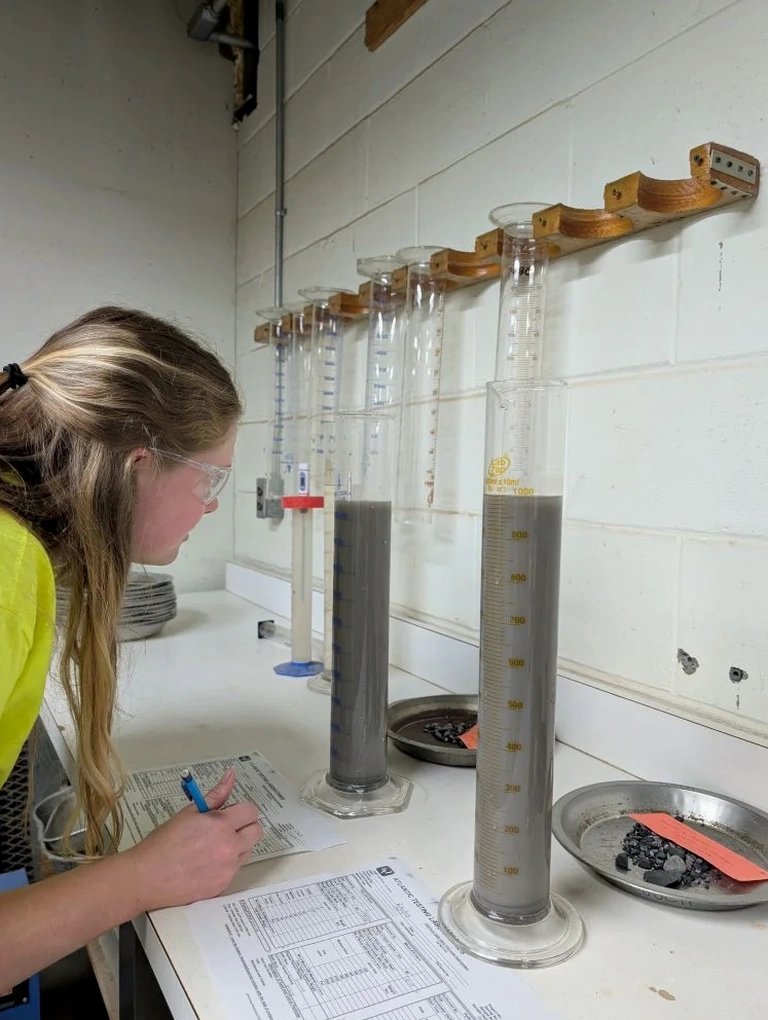
Brampton sits at roughly 230 meters above sea level on the South Slope of the Peel Plain, a landscape shaped by glacial Lake Iroquois and the last retreat of the Laurentide Ice Sheet. Beneath the subdivisions and industrial parks, the soil profile tells a story of lacustrine sedimentation: thick layers of silty clay interbedded with silt till, locally known as Halton Till. When public works and private developers push for new arterial roads or warehouse pads on these deposits, the subgrade rarely behaves like the textbook. A standard laboratory CBR test, run under controlled moisture and density conditions, becomes the reference for pavement section design, because guessing the bearing capacity of a local clay with published tables can overestimate support by thirty percent or more. In our experience across the Greater Toronto Area, pairing the CBR value from a grain-size analysis with a full compaction curve helps isolate fines content as the main driver of strength loss when the water table rises in spring. It is not just a number on a report: it is the link between Brampton’s geology and a pavement that stays serviceable through freeze-thaw cycles, heavy truck traffic from the intermodal terminals, and the occasional summer deluge that saturates the shoulder grade.
A single soaked CBR value on Halton Till tells you more about long-term pavement performance than a full season of deflection testing on an unsoaked subgrade.
How we work
The surficial geology across Brampton is dominated by the Halton Till plain, a dense, silty clay till that was overridden and compacted by glacial ice, then partially reworked by proglacial lake currents. What matters for pavement engineering is the weathered crust: the top 0.5 to 1.2 meters of oxidized, desiccated till that looks stiff in a test pit but softens dramatically when remolded and saturated. A soaked laboratory CBR test, per ASTM D1883, reproduces that scenario. The sample is compacted at optimum moisture content, submerged for 96 hours, and then penetrated at a controlled rate. The ratio of the measured force to the standard force gives the CBR value. We typically see values between 3% and 8% for the weathered Halton Till in its natural state, which places it firmly in the low-to-moderate subgrade category. When the project calls for a granular base course over a treated subgrade, we cross-reference the CBR with a
Proctor compaction test to verify that the specified relative compaction is actually achievable with the borrow material available within the municipality. For deep cuts in the same till, where the unweathered material shows CBR values above 15%, the pavement design can be optimized by reducing the granular base thickness, saving material and trucking costs without compromising the structural number. The test itself is deceptively simple in principle but demands precise moisture control, uniform compaction effort, and careful trimming of the soaked specimen before the piston touches the surface.
Local considerations
A recurring mistake we observe on Brampton sites is substituting a field CBR test on a dry, compacted subgrade in August for the laboratory soaked value, then designing the pavement based on that optimistic number. By the following April, when the frost is leaving the ground and the water table is peaking, the subgrade has lost half its stiffness, and the asphalt shows alligator cracking within two years. Another shortcut happens when the contractor runs a single CBR point at the site entrance and applies it to the entire length of the road, ignoring that the till transitions from silty to clayey over less than a hundred meters. The soaked laboratory CBR test is the only way to replicate the worst-case moisture condition that the subgrade will experience during its design life. Skipping it, or testing only the surface, leads to under-designed pavements that fail prematurely and cost the municipality or the developer far more in reconstruction than the price of a proper laboratory program. For flexible pavement design following the AASHTO 1993 method, the CBR is converted to a resilient modulus, which directly controls the structural number and the required layer thicknesses. A CBR error of two percentage points can translate into a granular base thickness error of 50 millimeters or more, multiplied over the entire road platform.