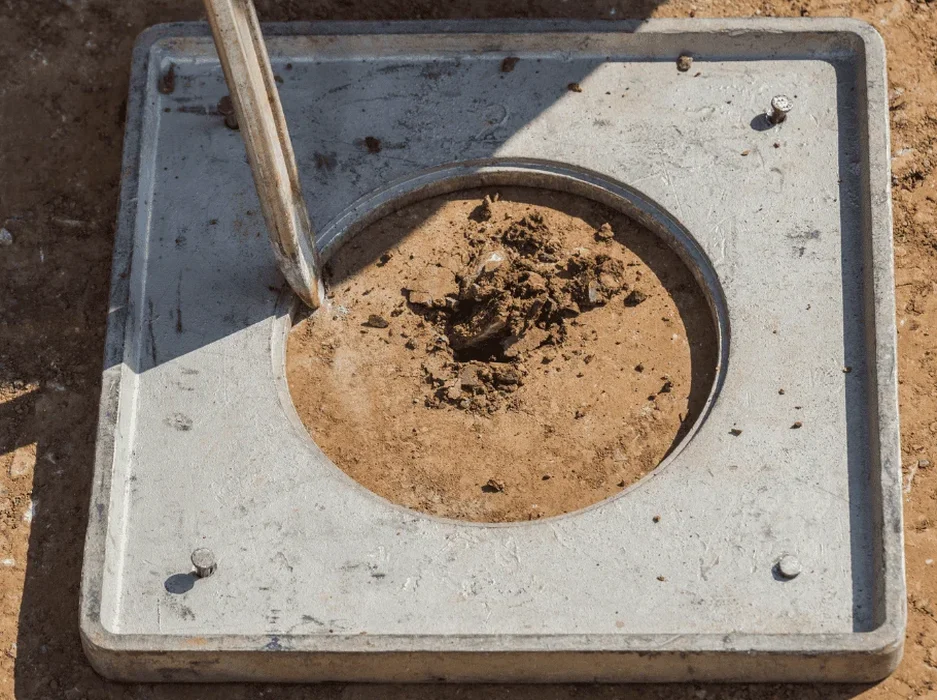
The glacial geology of the Peel Plain presents a specific set of challenges when assessing seismic risk—the dense Halton Till cap often masks deeper, loose saturated silty sand lenses that are critical for liquefaction analysis. In Brampton, where the water table can fluctuate significantly through the interglacial deposits between the Etobicoke Creek and the Credit River, a standard site classification without a specific liquefaction screening simply misses the hazard. Our team applies a combined approach using field penetration data and laboratory cyclic testing to quantify the factor of safety against flow failure. We integrate the city's municipal seismic design spectrum directly into the assessment, moving beyond generic screening to project-specific evaluation that aligns with the 2020 National Building Code of Canada.
The cyclic resistance of Brampton's silty fine sands is controlled by plasticity and fines content—standard clean-sand CSR curves will mischaracterize the actual hazard.
Applicable standards
NBCC 2020 – National Building Code of Canada, Seismic Hazard Tool, ASTM D6066/D6066M-18 – Standard Practice for Determining the Normalized Penetration Resistance of Sands for Evaluation of Liquefaction Potential, NCEER/NSF (Youd et al., 2001) – Summary Report on Liquefaction Resistance of Soils, CSA A23.3-19 – Design of Concrete Structures, Seismic Requirements
Common questions
What is the typical cost range for a liquefaction study on a commercial lot in Brampton?
Is liquefaction a real risk in Brampton given the low regional seismicity?
The seismic hazard in southern Ontario is moderate, but the presence of loose, saturated silty sands in the Oak Ridges Moraine and Peel Plain deposits means that a low-probability, high-consequence event cannot be dismissed. The NBCC 2020 uniform hazard spectrum provides the PGA values, and the geotechnical evaluation determines if the soil's cyclic resistance is sufficient.
How do you account for the Halton Till in the liquefaction assessment?
The Halton Till is generally not liquefiable due to its overconsolidated, dense, and cohesive nature. However, it acts as a caprock that can trap excess pore pressure in underlying loose granular layers. Our assessment focuses on the stratigraphy below the till, and we model the till as a confining layer that may delay but not prevent surface manifestation of liquefaction.
What is the difference between a screening and a detailed liquefaction analysis?
A screening uses standard SPT or CPT correlations (Idriss-Boulanger, Youd-Idriss) to estimate CRR and compare against CSR from the NBCC ground motion. A detailed analysis incorporates site-specific cyclic lab testing on undisturbed samples to calibrate the CRR curve, and numerical modeling of pore pressure generation and dissipation. The latter is required for Performance-Based Design under CSA A23.3 or for major infrastructure.