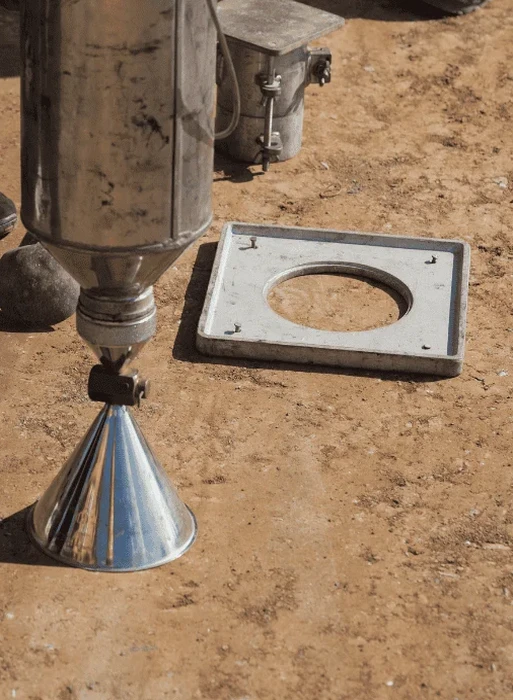
Brampton sits on a foundation of glacial till and silty clay plains, shaped by the last ice age over 12,000 years ago. With over 700,000 residents and a construction sector that never seems to slow down, the city's rapid expansion across the Etobicoke Creek and Credit River corridors means one thing: the structural fill under those new warehouses and townhouse blocks has to be right. The sand cone test, governed by ASTM D1556, remains the most straightforward field method for verifying that compacted soil actually meets the specified density. We run these tests daily on everything from sewer trench backfill near Queen Street to the granular base under industrial slabs in the Bramalea area. It is a destructive test by nature, but when combined with a Proctor curve from the lab, the numbers give you a defensible pass/fail on compaction for your inspection reports.
The sand cone method is the direct referee test for compaction—no calibration curves, no nuclear source, just a measured volume and a scale.
Local considerations
A common pattern we observe in Brampton is the rush to backfill service trenches during the November rains before the frost sets in. Contractors push to close the trench on the same day, placing lifts that are too thick for the compactor on site. The sand cone test on a 12-inch lift will often show adequate density at the top of the lift but significant under-compaction deeper in the layer, which later manifests as differential settlement across the patch. The Ontario Building Code references CSA A23.3 for concrete structures, but for the soil bearing beneath, the proof is in the compaction record. Another local issue is the presence of old buried topsoil lenses in the Halton Till, particularly in the older sections of the city near downtown. If the trench bottom is not properly inspected and the fill is placed over compressible organics, the density test on the granular backfill will pass while the overall foundation condition remains compromised. These are the practical realities that a density report alone cannot capture, which is why we always document the material type and any anomalies in the field log.
Applicable standards
ASTM D1556: Standard Test Method for Density and Unit Weight of Soil in Place by Sand-Cone Method, ASTM D698: Standard Test Methods for Laboratory Compaction Characteristics of Soil Using Standard Effort, ASTM D1557: Standard Test Methods for Laboratory Compaction Characteristics of Soil Using Modified Effort, Ontario Provincial Standard Specification (OPSS) 501 for compaction, CSA A23.3 for concrete structures, referenced in Ontario Building Code
Common questions
How much does a sand cone field density test cost in Brampton?
Can the sand cone test be performed on gravel or coarse aggregate?
The sand cone method per ASTM D1556 is best suited for soils with a maximum particle size up to about 1.5 inches. For larger aggregate, the test hole volume must increase significantly to be representative, and the error margin grows. In those cases, a replacement method using water or a calibrated rubber balloon may be more appropriate, but for typical granular A and B road base in Brampton, the sand cone works well.
What is the difference between a nuclear gauge test and the sand cone method?
The nuclear gauge measures density indirectly by detecting the backscatter or transmission of gamma radiation through the soil, which requires a calibration to the specific material. The sand cone method measures volume and mass directly, making it a primary reference standard. In practice, nuclear gauges are fast for production control, but the sand cone is used for acceptance testing, calibration checks, and dispute resolution because it does not depend on soil chemistry or a transfer curve.
How many sand cone tests are needed for a typical foundation pad in Brampton?
The frequency depends on the project specification, but a common rule in the Greater Toronto Area is one test per lift per 2,500 square feet of compacted area, with a minimum of three tests per lift for smaller pads. For a typical 10,000-square-foot industrial building pad, that translates to about four to six tests per lift, with lifts placed at 8 to 12 inches loose thickness.
Does the weather affect the sand cone test results?
Yes, and this is a practical concern in Brampton. The Ottawa sand used in the cone must be dry and free-flowing to achieve a consistent bulk density. Testing in the rain or on saturated ground introduces error because the sand can absorb moisture and its calibrated density changes. We typically reschedule tests during heavy rain, and for damp conditions we protect the sand and the excavated material carefully to avoid moisture gain.