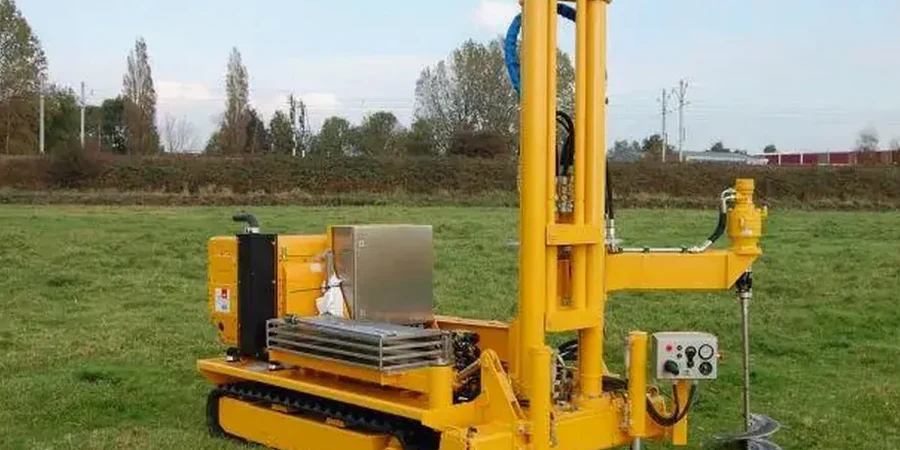
Brampton sits at roughly 230 meters above sea level on the South Slope, where the glacial stratigraphy can shift from dense Halton Till to softer glaciolacustrine deposits within a single project footprint. The 2016 Ice Storm and subsequent freeze-thaw cycles here have reminded every geotechnical engineer how critical accurate subsurface data is when designing foundations, and that is exactly why Cone Penetration Testing has become the preferred investigation method for developers working along the Credit River valley and across the city's rapidly expanding industrial parks. Our CPT rigs push a 15 cm² cone into the ground at a constant 2 cm/s, logging tip resistance and sleeve friction continuously to ASTM D5778 standards, which allows our team to identify thin sand lenses or soft clay pockets that a standard SPT setup could easily miss. For projects near the Etobicoke Creek floodplain, combining CPT data with a liquefaction assessment provides the soil behavior type index (Ic) needed to verify seismic performance under the NBCC 2020 provisions.
Real-time cone penetration data reveals the exact depth of the stiff Halton Till contact, eliminating the guesswork from foundation design in Brampton.
Applicable standards
ASTM D5778-20: Standard Test Method for Electronic Friction Cone and Piezocone Penetration Testing of Soils, NBCC 2020: National Building Code of Canada, Part 4, Seismic Hazard and Site Classification, CSA A23.3-19: Design of Concrete Structures (foundation references), Robertson, P.K. (2009): CPT Interpretation Guide
Common questions
How much does a CPT test cost in Brampton?
Can the CPT penetrate the Halton Till in Brampton?
The upper weathered till is often penetrable to 10–15 meters with a 20-ton rig, but the dense, unweathered Halton Till with its high cobble and boulder content can cause refusal. Our technicians monitor the sleeve friction and inclination in real time to stop the push before damaging the cone, and we then recommend a pre-augered pilot hole or rotary drilling to continue the investigation if necessary.
What is the difference between CPT and SPT for Brampton soils?
CPT provides a continuous digital log of tip resistance, sleeve friction, and pore pressure every centimeter, whereas SPT gives a blow count every 1.5 meters with disturbed samples. In the interbedded silts and clays of Brampton, the CPT identifies thin drainage layers and sensitive clay seams that the SPT hammer can easily miss, making it far more reliable for liquefaction screening and settlement analysis.
How long does a CPT test take on site?
A single CPT sounding to 20 meters in typical Brampton till and clay takes about 45 to 70 minutes of continuous pushing, plus 15 minutes for setup and calibration. If dissipation tests are requested at multiple depths, each pause adds roughly 15 to 30 minutes depending on the soil's consolidation rate.