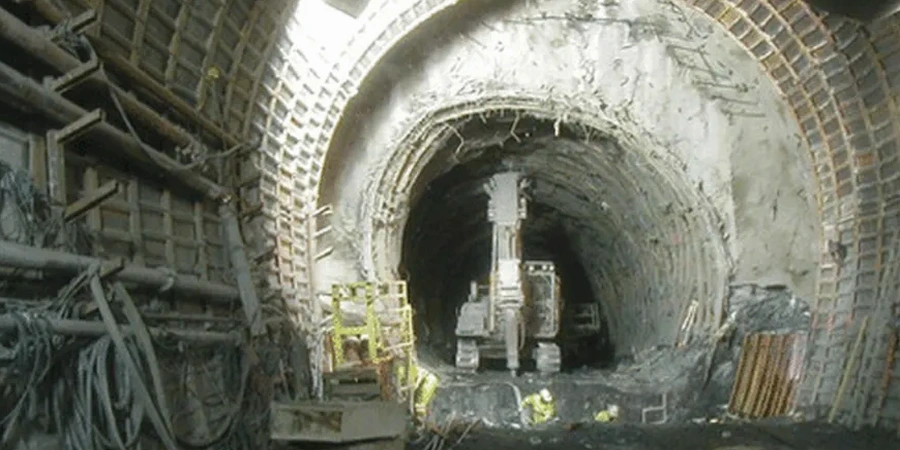
The triaxial cell pressure gauge reads steady at 85 kPa confining stress when we test the Halton Till samples from Brampton tunneling projects. Our lab team runs consolidated-undrained triaxial tests on Shelby tube specimens extracted from depths between 12 and 28 meters, right where tunnel alignments cross the glaciolacustrine silty clay deposits that dominate the city's subsurface. The Brampton ground profile is unforgiving for tunnel designers because the stratigraphy shifts abruptly across the Etobicoke Creek watershed. Between the dense till ridges and the soft clay basins, we run multiple triaxial suites and one-dimensional consolidation tests to build reliable stress-strain models. Before the TBM ever arrives on site, the laboratory program establishes undrained shear strength envelopes and consolidation parameters that feed directly into face pressure calculations and segmental lining design. For deeper alignments intersecting the Queenston Shale, we add rock core testing with point load index to capture the transition behavior between the soft overburden and the bedrock interface.
Brampton's glaciolacustrine clays demand triaxial testing under in-situ stress conditions because the undrained response controls face stability in closed-face tunneling operations.
How we work
The Brampton subsurface tells a story of glacial Lake Peel retreat, leaving behind layered deposits of fine-grained sediment with organic silt pockets near the Credit River floodplain. Our laboratory testing program for soft soil tunnels targets the two parameters that govern tunnel face stability in these conditions: undrained shear strength typically ranging from 25 to 70 kPa in the upper clay units, and the coefficient of consolidation that controls pore pressure dissipation rates during excavation. We run incremental loading oedometer tests following ASTM D2435, with load stages held for 24 hours to capture secondary compression behavior because the organic content in Brampton's near-surface deposits amplifies creep deformations. The team also measures Atterberg limits on every sample, and we frequently encounter plasticity indices above 30% in the glaciolacustrine clays north of Bovaird Drive, which directly impacts the soil conditioning requirements for closed-face TBMs. This laboratory characterization program runs parallel to field investigations, ensuring the design team receives complete geotechnical parameters before the tender stage closes.
Applicable standards
ASTM D4767 – Consolidated Undrained Triaxial Compression Test for Cohesive Soils, ASTM D2435/D2435M – One-Dimensional Consolidation Properties of Soils Using Incremental Loading, NBCC 2020 – National Building Code of Canada, Section 4.2 (Geotechnical Design), ASTM D4318 – Standard Test Methods for Liquid Limit, Plastic Limit, and Plasticity Index of Soils, CSA A23.3 – Design of Concrete Structures (for segmental lining reference)
Common questions
What laboratory tests are essential for soft soil tunnel design in Brampton?
The core testing suite includes consolidated-undrained triaxial tests under in-situ stress conditions, one-dimensional consolidation tests for settlement prediction, Atterberg limits to characterize plasticity, and permeability tests to quantify groundwater flow through the clay aquitards. For Brampton's glaciolacustrine deposits, we also recommend organic content determination because the organic silt pockets near the Credit River accelerate secondary compression, which affects long-term lining performance.
How does the local geology in Brampton affect tunnel construction?
Brampton sits on glacial Lake Peel deposits with alternating layers of soft silty clay, dense Halton Till, and occasional sand lenses. The soft clay units north of Bovaird Drive have plasticity indices above 30% and undrained shear strengths as low as 25 kPa, which requires careful face pressure control in closed-face TBMs. The transition zones between till ridges and clay basins create mixed-face conditions that demand detailed geotechnical profiling along the entire alignment.
What is the typical cost range for a geotechnical analysis for soft soil tunnels in Brampton?
How long does the laboratory testing program take for a typical tunnel project?
A standard geotechnical testing program for soft soil tunnel design takes approximately four to six weeks from sample receipt to final reporting. Consolidation tests require 24-hour load increments per ASTM D2435, which drives the schedule. Triaxial testing under consolidated-undrained conditions adds another two weeks for specimen saturation, consolidation, and shearing. We can expedite portions of the program when the contractor needs preliminary parameters for TBM procurement.
What NBCC requirements apply to geotechnical investigations for tunnels in Brampton?
Section 4.2 of the National Building Code of Canada 2020 governs geotechnical design for underground structures, requiring site-specific investigations that characterize soil and rock properties to a depth adequate for the proposed tunnel. For soft soil conditions in Brampton, this means sampling and testing through the full depth of the glaciolacustrine deposits and into the underlying Halton Till or Queenston Shale, with sufficient laboratory testing to establish design parameters for both ultimate and serviceability limit states.