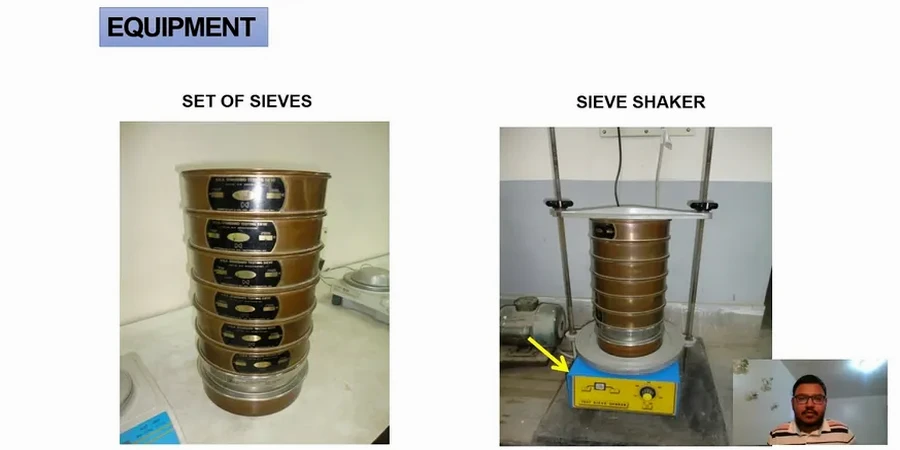
A full stack of ASTM E11 certified sieves, a mechanical shaker calibrated to 50 Hz, and a temperature-controlled hydrometer cylinder are the core instruments deployed for every grain size analysis supporting Brampton’s construction sector. The procedure separates coarse fractions through a nest of sieves from 75 mm down to 75 µm, while the sedimentation phase resolves silt and clay distribution below that threshold using Stoke’s law. For the heterogeneous glacial deposits found throughout Brampton—where Halton Till can shift from sandy matrix to clay-dominated facies within a single borehole—this dual method provides the particle-size curve that structural engineers rely on for drainage design, frost susceptibility classification, and compaction specification. Laboratories running these tests under ISO 17025 accreditation ensure that every hydrometer reading is corrected for temperature and dispersant viscosity, which is critical when footings are being sized for the low-permeability silts common in the Etobicoke Creek watershed.
A complete particle-size curve from 75 mm down to 2 microns is the foundation document for every defensible earthworks specification in Ontario.
Local considerations
A recurring mistake on Brampton infill projects is classifying foundation subgrade based solely on the sand and gravel fractions from a quick sieve stack, while ignoring the silt and clay percentages that only a full hydrometer analysis can quantify. This shortcut becomes expensive when a footing is placed on a soil layer with 40 percent silt content that was misread as ‘well-graded sand’—the result is differential settlement and water retention against the foundation wall during spring thaw. The Halton Till matrix often contains enough silt to be frost-susceptible under MTO F-1 criteria, and without a complete grain size curve showing the minus 75 µm fraction, the granular A-base thickness specified may be inadequate for Brampton’s 1.2-meter frost penetration depth. Owners who commission the full sieve-plus-hydrometer package before footing elevation is finalized avoid the costly cycle of re-excavation, additional granular placement, and delayed occupancy permits that plague projects where gradation data was incomplete.
Applicable standards
ASTM D422-63 (Reapproved 2007) — Standard Test Method for Particle-Size Analysis of Soils, ASTM D6913/D6913M-17 — Standard Test Methods for Particle-Size Distribution (Gradation) of Soils Using Sieve Analysis, ASTM D7928-17 — Standard Test Method for Particle-Size Distribution (Gradation) of Fine-Grained Soils Using the Sedimentation (Hydrometer) Analysis, ASTM D2487-17 — Standard Practice for Classification of Soils for Engineering Purposes (Unified Soil Classification System), MTO LS-702 — Method of Test for Grain Size Analysis of Soils (Hydrometer Method), ISO/IEC 17025:2017 — General requirements for the competence of testing and calibration laboratories
Common questions
How much does a grain size analysis (sieve and hydrometer) cost for a Brampton project?
How long does a hydrometer analysis take from sample submission to final report?
The sedimentation phase of the hydrometer analysis runs over a minimum 24-hour period to capture the full silt and clay distribution curve, with readings taken at standardized intervals defined in ASTM D422. Including oven-drying, sieving, and report preparation, the standard turnaround is five business days. Rush service can compress this to three business days for time-sensitive Brampton foundation inspections.
What is the difference between a washed sieve and a dry sieve analysis?
A washed sieve analysis, per ASTM D6913, uses water to separate the minus 75 µm material from the sand and gravel fractions before mechanical sieving. This is essential for Brampton’s Halton Till soils because the silt and clay particles adhere to larger grains, and a dry sieve alone would under-report the fines content by 10–15 percent. The wash method produces a more accurate gradation curve for USCS classification and frost-susceptibility assessment.
What sample size is required for a grain size analysis on Brampton till?
For the heterogeneous Halton Till typical of Brampton, a minimum 2 kg field sample is recommended to ensure representative particle distribution. The lab splits this to obtain a 200 g dry specimen for hydrometer analysis and a 500 g to 1 kg portion for sieve analysis, depending on maximum particle size. Samples should be sealed in moisture-tight bags immediately after extraction to preserve natural water content for correlation with Atterberg limits testing.