← Home · Investigation

SPT Testing in Brampton: Reliable N-Value Data for Foundation Design

Together, we solve the challenges of tomorrow.

LEARN MORE →

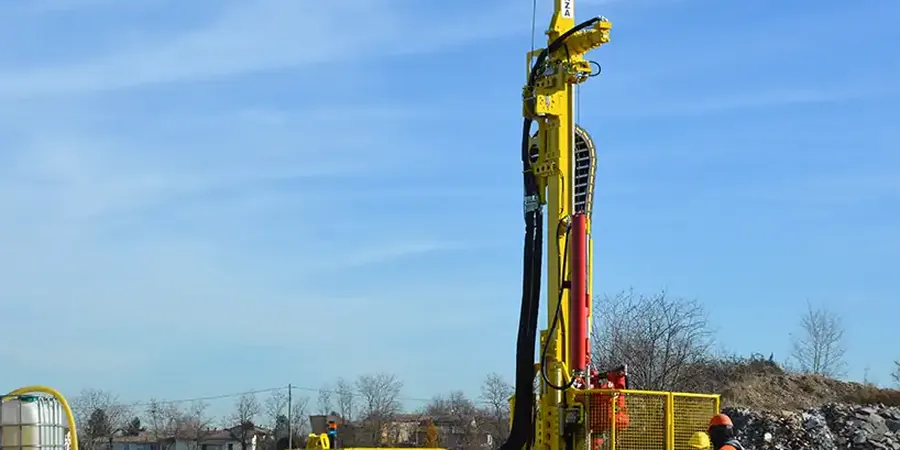
The rig arrives on site, a CME-75 track-mounted drill, towing a trailer with the safety hammer and AWJ rods. It's the setup we use across Brampton for the Standard Penetration Test — what most engineers simply call the SPT. The crew positions the split-spoon sampler, checks the 140-pound hammer is tripping cleanly at 30 inches, and starts driving. In this part of the Greater Toronto Area, where the Halton Till meets glaciolacustrine silts, every blow count tells us something about how the ground will behave under load. The grain size distribution we later run in the lab confirms what the sampler retrieves: dense silt till with occasional clay seams, typical of Brampton's Oak Ridges Moraine fringe.

An SPT N-value isn't just a number — it's a direct indicator of relative density and consistency, calibrated against decades of Brampton foundation performance data.

How we work

Brampton's subsurface isn't uniform, and that's where the SPT earns its keep. The northern half sits on the Peel Plain, underlain by clayey silt till deposited during the Wisconsin glaciation. Move south toward the Etobicoke Creek valley and you hit loose alluvial sands that can densify under vibration. The contrast is stark enough that two boreholes 500 meters apart can show N-values differing by a factor of three. Our drilling crew logs every split spoon recovery, noting changes in moisture, color, and consistency. For sites with marginal blow counts, we often pair SPT data with CPT testing to get a continuous resistance profile and pin down thin weak layers the spoon might miss.
SPT Testing in Brampton: Reliable N-Value Data for Foundation Design
Technical reference image — Brampton

Local considerations

The Halton Till underlying much of Brampton is a dense, overconsolidated diamict — but it's not everywhere. The Credit River and Etobicoke Creek corridors contain post-glacial alluvial deposits that are loose and saturated, which raises liquefaction potential under the seismic demands of the NBCC 2020 for the Greater Toronto Area. We've pulled split spoon samples from silty sand layers at 6 meters depth that barely registered an N-value of 4, while the till above logged above 50. Skipping the SPT in these transition zones means designing on assumptions that don't hold. A few boreholes with proper blow count logging and soil classification are the difference between a footing that performs and one that settles differentially.

Need a geotechnical assessment?

Reply within 24h.

Email: contact@geotechnicalengineering.co

Typical values

ParameterTypical value
Standard ReferenceASTM D1586-18
Hammer TypeSafety hammer (donut hammer on request)
SamplerStandard split-spoon, 2" OD, 18" length
Drive Weight140 lb (63.5 kg)
Drop Height30 in (760 mm)
Typical Borehole Depth10 to 30 m below grade
Energy CorrectionN60 reported per Seed & Idriss
Sampling IntervalEvery 1.5 m or at stratum change

Other technical services

01

Soil Classification & Index Testing

Every split spoon sample goes through visual classification per ASTM D2488, with selected specimens tested for grain size distribution and Atterberg limits. This ties the blow count to a specific soil type, which is essential for bearing capacity calculations in Brampton's varied glacial stratigraphy.

02

Foundation Design Parameter Reports

We convert corrected N60 values into allowable bearing pressures, settlement estimates, and lateral earth pressure coefficients. For Brampton projects, the report includes frost depth considerations (1.2 m per OBC) and seismic site class per NBCC Table 4.1.8.4.A.

Applicable standards

ASTM D1586-18, NBCC 2020 (seismic provisions), CSA A23.3 (concrete foundations)

Common questions

How much does SPT testing cost in Brampton?
How deep do SPT boreholes need to go in Brampton?

Most Brampton projects target 10 to 15 meters, which gets you through the weathered till crust into competent material. For taller structures or sites near the Etobicoke Creek valley, we extend to 20 or 30 meters to check for loose alluvial sands at depth. The Ontario Building Code requires investigation to a depth where the stress increase is less than 10% of the effective overburden pressure, which we calculate per borehole.

What N-value indicates good bearing soil in Brampton?

In the Halton Till that dominates Brampton's geology, corrected N60 values above 30 are common below the weathered zone and indicate very dense, high-capacity material. Values between 15 and 30 suggest medium-dense conditions that can still support shallow footings with proper sizing. Anything below 8 in granular soils prompts a closer look — we typically recommend deeper borings or alternative foundation types when we encounter those numbers.

Do you report raw N-values or corrected N60?

We report both. The field log shows raw blow counts per 6-inch increment, and the final report includes N60 values corrected for hammer energy, rod length, borehole diameter, and overburden pressure. For Brampton sites, energy correction is critical because the safety hammer efficiency can vary between 45% and 70% depending on the rig setup, and uncorrected values can be misleading for liquefaction or settlement analysis.
Location and service area

We serve projects across Brampton and surrounding areas.

View larger map